Vital: Remote Patient Monitoring
A thesis project on continuous remote vital-sign monitoring with predictive ML insights.
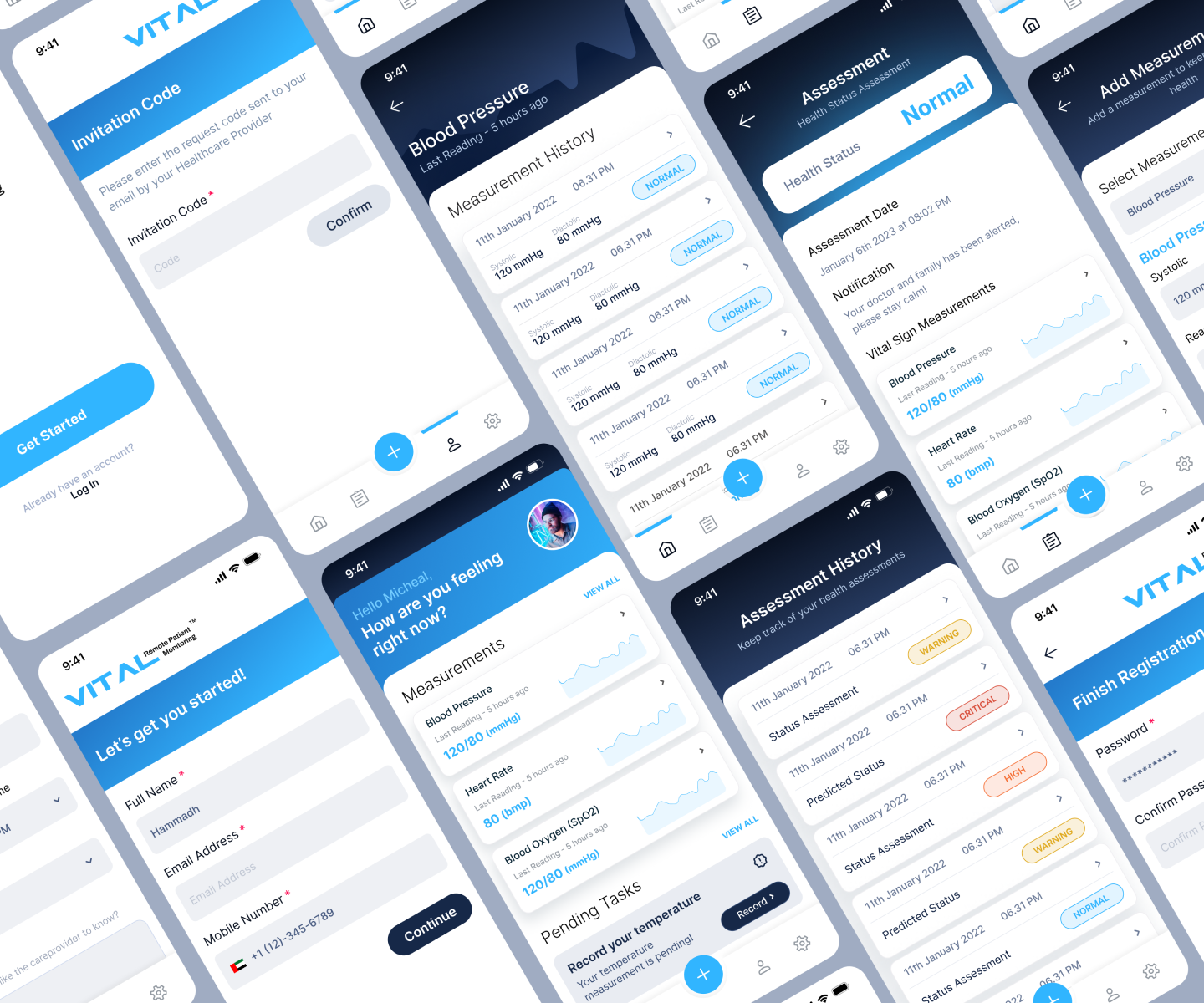
Context
Vital was my final-year research thesis at the University of Westminster (2022–2023). The brief: continuous remote monitoring of patient vital signs with proactive insight, not just reactive dashboards. The audience was clinicians who today have to choose between on-site monitoring (high cost, limited reach) and self-reported home check-ins (unreliable, low signal).
What I built
- Mobile front-end in Flutter, paired with OMRON BP monitors over BLE for real-time blood-pressure capture.
- Hybrid ML pipeline on Flask + Python for multivariate vital-sign analysis and time-series forecasting of physiological parameters.
- Firebase backend for clinician–patient sync, alerts, and historic record review.
- Predictive insights surface that flagged patterns suggesting risk of deterioration, before any single reading crossed a threshold.
How it works
The forecasting model combined classical time-series techniques (ARIMA on slow-moving signals like BP trends) with shallow neural nets for short-horizon multivariate forecasts. It was deliberately lightweight so it could run inference on a small Flask host — the design constraint was that this had to be deployable somewhere a small clinic could afford, not just AWS.
Outcome
Submitted as final-year thesis; ML pipeline demonstrated successful forecasting on test datasets and the clinical workflow handled real BLE devices end-to-end.
Reflection
Looking back, the thing I’d change is the data layer. I picked Firebase because it was fastest to ship for the thesis deadline; for a real clinical deployment I’d reach for Postgres + a proper time-series extension. The forecasting model also assumed cleaner signal than real-world wearable data ever produces — anyone shipping this into the field would need a much more aggressive smoothing layer.